Goldsboro Books or 84, Charing Cross Road

84, Charing Cross Road was where my love for the English bookshop began.It was a major cult novel that Helen Hanff claimed never made her much money, but apparently made her many strange friends instead.

And her readers were certainly devoted. At a time when long distance calls, and international calls, were much more expensive, a woman rang her up out of the blue from Alaska or Canada or some other remote point because this telephone call to Helen Hanff was her husbands birthday present for her. People kept sending her books to sign and then send on for gifts, and she grumbled that she actually lost money on it: the money she got from royalties were less than what she paid on postage to send it along.

If you haven’t read it, I can warmly recommend her subsequent, perhaps less known, book The Duchess of Bloomesbury Street – it’s about her visit to London, when it did take place, and very much about how much warmth and strange friendship a good book can bring about. When the shop on 84, Charing Cross Road closed, a fan had the sign from the store shipped to her. It hanged for many years in her living room.

Why am I telling you all this when I’m supposed to write about Goldboro Books? Well, I’m trying to explain to you how it was that when, having joked with Louise about buying a first edition, and asked what the first edition Harry Potter costs (they sold it as a set, so more than one book, otherwise I’d spent the 4000 pounds needed to get it, etc. etc.) and then, noticing 84, Charing Cross Road in a humble, almost hidden spot on a shelf, I immediately froze.

“It’s 84, Charing Cross Road!” I said to Louise, and reverently picked it up after a tentative – “May I?” – do the woman who worked there.
“You should take a photo with it”, said Louise, bless her innocent heart.
“Photo! I think I’ll have to buy it.” I think Louise was a little bit afraid that all the bookshops had gone to my head, and even the shopkeeper seemed a little hesitant about the quickness of my decision. “Are you sure?” she said.
“What would your sister say?” was Louise attempt at reason. She knows me too well already.
“My sister would approve”, I said with great dignity.
Which she will, especially if I don’t tell her how much it was. Besides, my sister is an artist. She understands obsessions very well. It’s only when my obsessions lead to buying so many books that we have to move to a bigger apartment that she is a little bit less supportive. At least right now, since we moved to a bigger apartment just one year ago.
“Besides, it is only one book”, I said to Louise. “The rule didn’t say anything about a price limit.”

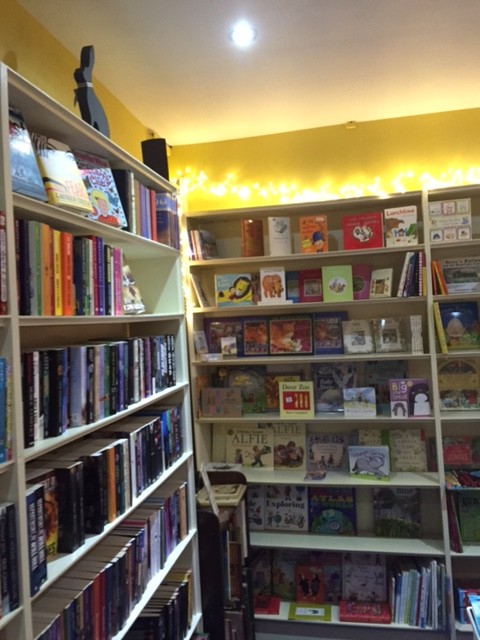
AND IT IS BEAUTIFUL (just like the Goldsboro Bookshop).

One day I’ll finish the collection with a signed copy. But let’s not tell Louise or my sister.
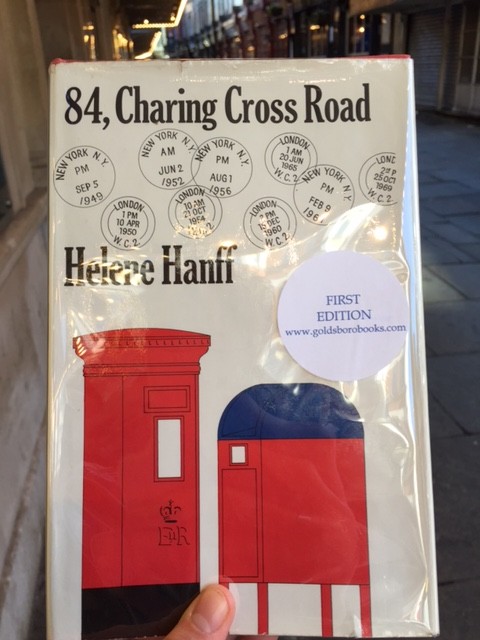
Isn't she a beauty?

Hatchards: the oldes bookshop in London

Hatchards is London’s oldest bookshop, established in 1797. They’ve occupied the same building on 187 Picadilly for over two centuries, catering to royal households of Britain and europe as well as strange Swedish authors.

This was the bookshop where I first came across these lovely editions from Perspephone (see image), a publisher which reprints “neglected fiction and non-fiction by mid-twentieth century (mostly) women writers” – and not only reprints them, but reprints them in these beautiful, classically grey editions. Who came up with the idea of having most of the books grey, and then breaking off every now and then with an image? I bought Mrs Pettigrew lives for a day, and it’s a warm, charming, great book. I read it when I came home that same evening; a perfect way to spend hours in bed doing nothing.

Bookseller’s recommendation: The Bees

Bonus book-that-doesn’t-count-at-all-because-it’s-more-of-a-pamphlet: The Unknown Unknown – bookshops and the delight of not getting what you wanted

Heywood Hill: the exceptions begin

Heywood Hill on 10 Curzon Street, Mayfair, was the very first bookshop I visited yesterday, and also the first time my strict one-book-rule was broken. Well, it’s more of a guideline anyway,

The glorious, sunshine-bookshop-filled day began at this lovely bookshop, situated on two floors of a Georgian townhouse. Nancy Mitford used to work here during the world, when her “gregarious character and witty repartee helped establish Heywood Hill’s shop as a centre of English social and literary life during the 1940s”. Legend has it that one evening Nancy forgot to lock up the store. When she arrived the following morning she found the shop full of people trying to buy books from each other.”

The Nancy Mitford-story naturally got me thinking: what modern-day cultural figures would I most like to have working in a bookshop? Me, I would quite like to walk in there and find Stephen Fry behind the till. Am sure he would give excellent comments on the books, as well as life, politics and religion and any other topic he happened to broach.

The Heywood Hill sells literature, history, architecture, biography and travels, but I think the manager saves her real passion for the well-stocked children department, filled with old and new classics. “I love children’s books. It’s where you find the best stories today. But they have to be published with pride. These are the books you want to be able to give as a gift, or pass down to your own children, or save and re-read when your older. Just look at this beautiful edition of Anne of Green Gables. Or this one, of Little women. We have to other editions as well, but one is quite hideous. We’ll never sell it. Just compare these two. Or this” – looking sternly at Louise and showing her another title – “Beautiful books, but only three of them are published in hardback. By your publisher. The rest are paperback. How can you give that away as a gift? And these are lovely. Just look at the amount of work and details pride that’s gone in to all of these?”

Which was quite true about the children department and Heywood Hill in general as well.

Books bought: Five children and it and Five children at the Western front. 

So many lovely details
And so many lovely books

First impressions

First impressions are, I know, very important. When it comes to fully mastering English greetings I had closely studied the first chapter in Watching the English – The Hidden Rules of English Behaviour.

It came as a relief to find the chapter, since all my previous knowledge on English greeting etiquette came from Julian Fellowes novel Past Imperfect. In said novel, part of the plot depends upon the correct way to greet new people: “How do you do?” – “How do you do?”. As in not the vulgar “nice to meet you”. I had a strange feeling, howver, that it might not be quite up to date, and in any case, it depended on the person I met to actually begin the conversation with a “How do you do”, which I have yet to experience anyone actually doing.

So I turned to Kate Fox to update my knowledge.

Under the heading The Rules of Introduction it stated the following about the English greetings:

Number 1: The Awkwardness Rules

As it is, our introductions tend to be uncomfortable, clumsy and inelegant. (…)

The French custom of a kiss on each cheek has become popular among the chattering classes and some of the middle- and upper-middle-class groups, but is regarded as silly and pretentious by many other sections of society (…) Even in the social circles where cheek-kissing is acceptable one can still never be entirely sure whether one kiss or two is required, resulting in much awkward hesitation and bumping as the parties try to second-guess each other.

Handshakes are now the norm in business introduction – or rather, they are the norm when people in business are introduced to each other for the first time. Note, though, that the English handshake is always somewhat awkward, very brief, performed ‘at arm’s lenght’, and without any of the spare-hand involvement – clasping, forearm patting, etc. – found in less inhibited cultures. (…) At subsequent meetings, particularly as business contacts get to know each other better, a handskae greeting often starts to seem too formal, but cheeck-kisses would be too informal (…). Hands are half-extended and then withdrawn or turned into a sort of vague wave; there may be awkward, hesitant moves towards a cheeck-kiss or some other form of physical contact as an arm-touch – as no contact at all feels a bit unfriendly – but these are also often aborted half-way.

This was not encouraging, since the only acceptable Swedish way of greeting is the half-hearted, embarrassed hug. Cheek-kisses confuse us, handshakes might be fine in strictly first-time-business-meetings, but anything more informal than meeting your boss for the first time requires a hug. And she didn’t even mention them, presumably considering them much too personal.

My only option was to really go for the general awkward-confused-embarrassed greeting, hopefully mistaken for Englishness, and possibly combining an aborted hug, a confused second-guessed cheek-kiss, and a hand shake.

I am happy to say that I got the confused-embarrassed-awkwardness at my first try.

After the greetings, things were much more unclear. Gossip apparently takes up some 65 % of the conversation (same for both men and women), but that was hardly applicable here since I don’t know anyone to gossip with them about. Next up, under the promising heading Female Bonding (perfect!), was The Counter-compliment Rule.

The Counter-compliment Rule states that English female bonding-talk often starts with a ritual exchange of compliments. The trick here is apparantly never to accept them. “Your hair looks great” – “No, no, I only wish I had hair like yours. And that’s a lovely dress!” – “This old thing? It makes me look …” etc.

I duly followed it, but since both Becky and Louise began with kind compliments about my book, I ended up telling them that I couldn’t write at all, and that theirs were much better, which was a, incomprehensible since they haven’t, as far as I know, written a book and b, perhaps not a great thing to say to your publisher and publicist.

Oh well.

At least I was on firm ground when it came to goodbyes. Kate Fox has a lot to say there, mainly that there should be a lot of them, dragging on, never really finishing, suddenly starting all over again, etc., so that when guests finaly leave, everyone is instantly relieved and says something like “Pew, I thought she’d never leave” or “Finally!”

I am proud to report that I managed that one quite well.

Ps. Weather talk! Very difficult as a foreigner. I’ve tried both commiserating and complimenting the rainy, grey February day, but any bemoaning the weather as a foreigner is, as Kate Fox points out, an insult to all true and noble patriotic feelings, and any attempt to flatter them about their English weather on a grey and rainy February day makes you look, well, bat-crazy. But the sun is shining today, so might have more success.

Buy Watching the English here, if you too want to try to blend in as an Englishman.

The first hitch

“To: Court, Louise (@randomhouse)
From: katarina@katarinabivald.se
Subject: Re: February Tour – Itinerary

Dear Louise,

The itinerary looks great, and I’m really looking forward to finally meeting you! However, I do have a slight problem. Is it possible to send books to your office by post during my travel, and then collect them in London before flying back to Sweden?

Yours,
Katarina”

Ten minutes earlier:
Me, sitting in the sofa, reading Mansfield Park, to my sister, sitting next to me with her embroidery: “I’ll really have to travel lightly with all those buses and train rides.”
My sister: “Mhm?”
Me: “Yes, but I think it will be quite fun, actually. I’ll have to plan the packing, not just throwing as many clothes as I can fit in to the suitcase, but selecting a few sweaters and jeans, making sure everything matches…. keeping everything down to a minimum, you know.”
My sister, barely looking up from her embroidery, the “s” in Art sucks that she was currently working on: “But what are you going to do about the books?”
Me: “…”

So my new plan:
– Send books ahead by post
– Possibly ship them to Sweden, or
– Buy new suitcase in London for them (note: 23 kg)
– Introduce strict one book-rule: even if shipping the books, I am going to have to enforce some sort of limitation.

One book per bookshop. It’s going to be fine. Really. Maybe even fun. A sort of creative handicap.

Absolutely no problem.